5: The Dynamics of Eurasian Geography
- The Great Arid Zone only good for nomadic herding
- Geography leads to bi-cultural development
- The Warrior Morality
- Dynamic consistent throughout Eurasiafrican history
- Even Language Family of 2 cultures is different
Previously Chapter 7
To understand the cultural significance of these breaks, let us look at the greater Eurasian geography. It has had a huge impact upon the historical development of the planet.
The Great Arid Zone only suitable for nomadic herding
On the continental scale, there is an enormous swatch of arid land that divides the Eurasia-African mega-continent. It extends all the way from northwest Africa to northeast Asia. It contains large patches of barren land, which include both the Gobi dessert in the east, the Saudi Arabian desert in the middle and the Sahara desert in the west.
In the western part of the swatch, i.e. North Africa through to Saudi Arabia, the natural habitat includes ‘scattered broad-leafed deciduous scrubs’ around the perimeter of the barren lands. In the east from Iran, through the Tibetan Plateau and then to the Mongolian Plateau, the natural vegetation is categorized as ‘patches of grass’. In contrast the great plains of the Midwest in the United States are characterized as ‘grassland’. We will call this Eurasia-African territory 'The Great Arid Zone'.
The barrenness of much of this huge territory, which spans continents, is only matched by the arctic bleakness of Antarctica and Greenland. The aridity is found nowhere else in the Western Hemisphere. This extremely arid environment is also found in parts of Australia .
The Great Arid Zone consists primarily of desert and mountain soil that is not arable. This massive area, which spans half the globe, is considered an areic region because it contributes nothing to the water drainage areas of the world. The only exceptions in this band of dryness are small swatches that are deemed endoreic because their water never reaches the ocean. In short the only use that this land is fit for is nomadic herding. And much of the land in this zone, especially in northern Africa is even unfit for this.
Arid Band divides Eurasia-African landmass in half
This enormous swatch of arid land cuts across the Eurasian/African continental system. It separates southern Asia, including China and India, from northern Asia, i.e. Russia and Siberia. It also isolates southern Africa from Europe. This Great Arid Band is unsuitable for farming and so separates the agri-cultures of the south and north.
Geography leads to bi-cultural development
Eurasia-Africa breeding ground for nomadic and agri-cultures
This huge band of arid land that sweeps through the center of the main landmass of the Eastern Hemisphere, Eurasia-Africa, was the breeding ground for the great nomadic cultures. Additionally the geography of this super continent led to the formation of agricultural civilizations in China, India and the Mediterranean area, including Egypt, Mesopotamia, and Europe. Each of these areas is notable for having fertile river basins suitable for the development of agriculture. Hence inherent in the geography of this north-eastern quadri-sphere of the Earth is the development of two competing lifestyles that would inevitably come into conflict.
Agri-culture leads to earth worship
With the development of agriculture came settlements of people, from which comes cities and then civilizations. The agricultural lifestyle is sedentary, ideally suited for development of arts and crafts. The agri-cultures tend to be very in touch with the earth in that it provides sustenance. Agri-cultures tend to worship the earth. Cultivating the earth is seasonal. The earth must be prepared, the seeds planted, the plant cultivated and harvested over the course of a year.
Nomadic culture leads to sky worship
As opposed to this, the nomadic lifestyle of pastoral cultures is unsettled and constantly moving. When the flock has finished grazing in one area the entire tribe moves to another area. The ever-growing nomadic tribes began running into each other as they moved around. Instead of negotiating peacefully, they fought for valuable, because sparse, grasslands. The nomadic cultures developed a love of conflict and war. They do not tend the earth, but instead take from it. They do attend to the sky that provides water for their grass. As such, these nomadic cultures tend to worship the sky. The sky gods can be fierce and unforgiving just like the climate.
Nomadic Culture takes from the Agri-Cultures
Mother Earth has only given these nomadic cultures patches of grass, which they never tend. There is nothing to love her for. The sky waters her and grass grows. When things get tough, these nomadic cultures move on or fight. They do not stay to work things out. They do not cultivate. The sky does not negotiate, neither do they. Because they take from the earth without giving anything in return, it is also natural that they take from the rich agri-cultures of the world without contributing any service, except protection from other aggressive cultures.
Inevitable aggressive dynamic
The conflicting dynamic between the agricultural societies and the nomadic societies is inherent to the geography of the Eurasia-African continent. Pockets of craft-oriented agri-cultural civilizations would form around the rich river valleys of Eurasia-Africa. Simultaneously nomadic cultures would accumulate in the aforementioned grassland band. As the agricultural civilizations cultivated the sedentary lifestyle associated with arts and crafts, the nomadic cultures cultivated the innate militarism of the herding lifestyle. Inevitably the nomadic cultures would invade, taking what they wanted from the agri-culture. This political dynamic certainly played a significant role in Chinese history.
The Warrior Morality
We’ve alluded to certain characteristics of these military aristocracies. Let us enumerate some of them.
Man rates higher in warrior culture
In the nomadic warrior culture based upon aggression, confrontation and war, the stock of the man rises considerably because, as a warrior, he is the protector of the culture. Hence the nomadic cultures tend to worship a male sky god of war. In the constant battle between these warlike nomadic tribes for scarce resources, the tribe with the stronger war god wins, while the tribe with the weaker god is enslaved. Within these nomadic cultures, survival and power trump the quest for peace and contentment. Morals are associated with the acquisition of power.
Woman considered man's property
While the man’s status rises in a military culture, the woman’s status falls. In hunter-gatherer cultures of the Stone Age, i.e. the Paleolithic, fertility was of utmost importance – the fertility of both the woman to produce babies and of Nature to produce more game and fruit. Due to the development of agriculture in the Neolithic, the food source and population stabilized. In the aggressive Metal Ages that followed, cultural survival replaced fertility in importance. Similarly, women became livestock to be protected, rather than a source of inspiration and veneration.
Cultural survival was based primarily upon the level of military technology rather than upon how well a society cared for its citizens. The warrior became the most important individual with the rest of humanity his property or slaves. In other words, the militarily dominant cultures subjugated the majority of the population. While a time of technological expansion, the Bronze and Iron Ages were neither a good time for women nor the agrarian under classes that provided the labor. If one starts at a point of equal rights, then the Bronze Age would have to be considered a major step backwards relative to sexual equality and human rights, especially women’s.
Morality based upon Competition for Power
Initially the nomadic warriors were only raiding groups. But they inevitably came to enjoy the relative comforts of the agricultural climate and the pleasures of civilization and so decided to stay. However they did not stay and become farmers like the rest. They had always taken from the earth and had never cultivated her. Similarly, they took from the indigenous agri-cultures. The nomadic cultures came a-conquering and placed themselves at the top of the political system. As members of the ruling military aristocracy, they continued taking from the earth. Their rationale was simple. A real ruler takes from the earth, he does not till the earth.
Survival of the Fittest
Due to their hostile and competitive environment, nomadic cultures participated in a warrior culture. There is an entire complex of concepts associated with the warrior culture that have existed all over the world. A sampling of examples: the Samurai of Japan, Norman Europe, the Vikings of Scandinavia, the Plains Indians of America, and the Mongols of the Asian steppes. These cultures did not connect to share their belief systems. Instead these beliefs are inherent to the warrior culture because of the universality of beliefs associated with Battle.
Central to the warrior culture is the idea that battle is the ultimate test of a human’s abilities. The Warrior must reside in the Here and Now to survive the Battle. In the Battle there is an immediacy of experience associated with heightened sensibility linked with the adrenaline rush that allows survival for the fit. From this battle mentality emerged the concept of ‘survival of the fittest.’
Fitness
Accompanying the concept that the fit survive, is the desire to be fit. Thus associated with warrior cultures everywhere are fitness programs designed to maximize the chances of survival and/or winning. As a contrast, in the agri-cultures one’s fitness was associated with getting the work done. Modern sports are an example of the warrior culture. Incredible amounts of time and energy are expended upon fitness for the sport while accomplishing absolutely nothing productive, except for good health. The purpose of sports fitness is to maximize physical potentials for the Battle of the Game.
Mandate of Heaven
There is yet another belief complex inherent to the Battle. One aspect of survival in battle is based upon fitness, mental and physical. The other aspect is based upon pure chance. While preparation improves the warrior’s possibility of survival, it doesn’t guarantee it. In man’s time honored fashion, he rationalizes his survival as divine intervention. If the warrior and his army survive to conquer again, it must be because God has willed it. The concepts of Manifest Destiny in America, Divine Right of Kings in Europe, and Mandate of Heaven in China are all associated to this rationalization.
Might makes Right
In accordance with the concept of divine will comes the justification that might makes right. If we have been allowed to survive and conquer, it has been because God has willed it. The Sky God in all his power must want me to have it, if he has allowed me to take it. Hence if the all powerful sky god has allowed it to happen it must be right. Our behavior is justified by our success. Let the almighty God’s will be done.
Almighty all powerful god
One other belief that emerges out of this complex of warrior beliefs is that of the all mighty God. In the beliefs associated with agri-culture, there is a moral code independent of outcome. Just because someone is stronger and can take your possessions by force doesn’t mean that God is on his side. In fact Laws are made in agricultural civilizations to codify what society, independent of God, considers to be right and wrong. This is quite different from the warrior culture, where outcome is defined as right because of the belief that the almighty God makes it so.
In many primitive cultures, the supreme god is not all-powerful. Many times, he is held accountable and even punished for poor results, i.e. drought or famine. Conversely in the warrior cultures, of which Western culture is a derivative, all happens by God’s will and hence outcome determines morality or rightness.
Present day manifestations
The military aristocracy in every culture has felt beyond the law of the land. This is why justice is administered differently for the rich and poor. The powerful in every time period have felt justified in exploiting the poor or primitive cultures. They base this attitude upon the following notion. Because the all-powerful, all-knowing God has allowed our culture to exploit and even enslave other human beings, then it must be right.
The citizens of the world demand laws to protect them from the abuses of power. However, if the powerful are strong enough they ignore the laws. Under this way of thinking, power justifies behavior, independent of morality. In fact, power frequently determines morality for the mighty.
Political Dynamic consistent throughout Eurasia-African history
Because of the geography of the northeastern quadri-sphere of the Earth, civilizations have experienced a common political dynamic. Throughout history, nomadic tribes from the Great Arid Zone have regularly conquered the agricultural civilizations in all the great river valleys of Eurasia-Africa. Most, if not all, of the great nomadic cultures emerged from the Great Arid Band. The Kurgans moved into and conquered the Old European Culture, the Aryans moved into Dravidian India, and the Shang conquered China. In more recent times, the Moslems dominated North Africa, the Middle East, Iran, and Central Asia. Also the nomadic sky god worshipping Mongols left the Central Asian Steppes to conquer all the territory between and including Turkey and China.
Descriptive rather than pejorative
Lest there be any misunderstandings, each culture developed according to the geography of the land rather than by any moral choice. Hence the writer is not trying to assign a pejorative meaning to the nomadic cultures. The preceding discussion attempted to be descriptive rather than moral.
The Geographical dynamic responsible for modern super civilization
Furthermore this writer suggests that this geographical dynamic might have been responsible for the growth of large centralized civilizations, which have led us to modern times, for better or worse. Agri-cultures are by nature are sedentary, while nomadic cultures are dynamic. The down side of sedentary is static, while the down side of dynamic is flighty, unsettled. Dynamic stimulates sedentary and sedentary settles dynamic. One without the other is incomplete.
Nomad-farmer conflict stimulates growth
As an example, the nomadic cultures by themselves don’t produce architecture, cities, or anything permanent. The agri-cultures left to themselves tend to be focused upon food production. Without the grounding of the settled agrarian cultures, the nomadic culture has no root. Hence they leave nothing behind to mark their sojourn on the planet.
When the nomadic military aristocracy is overlaid upon the indigenous agri-culture, civilization results. Because agriculture is so labor intensive, the farmer had little time for the arts, philosophy, or science. Since the farmers provided food for the ruling class, the military aristocracy had the leisure time to write, read, and support the arts and sciences. The refinements of culture result from leisure time.
The ruling and underclasses have a co-dependent relationship. The military aristocracy cannot exist without the peasant agricultural base providing sustenance. And the agrarian population cannot exist without protection from the military class. Further the aggressiveness of the military aristocracies led to a cultural mixture that stimulated growth and innovation. Reiterating: the dynamic between the nomadic and agri-culture led to great advances for world civilization.
Foreshadowing some themes:
Simplistically speaking, the nomadic culture from the Arid Zone overlaid upon agricultural China became aristocratic Confucianism. In contrast, Taoism finds it roots in the shamanistic traditions of the prehistoric fertility cultures. In general, the world is dominated by religions emerging from the nomadic cultures. Taoism is unique among te major religions in that it does not have its roots in patriarchal military cultures. Instead Taoism emerged from the preceding egalitarian societies. Male domination vs. female cultivation.
Even Language Family of 2 cultures is different
As is evident, the geographical differences of the Eurasian-African mega-continent laid the foundations for the development of 2 distinctly different cultures. The geography also created 2 distinctly different language groups. The nomadic tribes living in the eastern half of the Arid Band, i.e. Central Asia, speak languages in the Altaic language group. Languages in the family include Mongolian and Tungusic (Manchu) in the east and Turkish thousands of miles to the west. Some linguists even include Korean and Japanese in this group. The cultures of the western part of the Arid Band primarily speak Arabic.
While the eastern nomadic cultures speak languages in the Altaic language group, the cultures to the south of the Arid Band speak languages in the Sino-Tibetan language group. This includes Chinese, Vietnamese, Burmese and Tibetan. There is no linguistic connection between the Altaic and Sino-Tibetan languages.
“There is no known linguistic relationship at all, however, between the Chinese and their various northern neighbors, with whom they have struggled throughout history.” China to 1850, p. 7
This division is easy to see in the map of the language groups of Asia seen below.
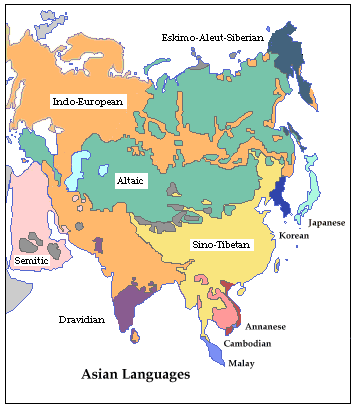
These major linguistic differences are an indication of the cultural diversity of Asia. While Europe and the Americas have one major language group, Indo European, and a few very minor language groups, Asia contains four major language groups and a multitude of minor language groups within its borders.
To reiterate, the cultures of the Arid Band of Central Asia, including Turkestan, Mongolia, and Manchuria, all speak languages of the Altaic language group. In contrast, the Chinese, Tibetan, and Burmese cultures speak languages in the Sino-Tibetan language group. Although they share a common border, there is no connection between these two language groups. The reason that these two language groups developed separately is geographical in nature. There is a deep-seated cultural difference inherent in these 2 language families.
Because of geography, China was and is an agricultural civilization. Warlike nomadic tribes inhabited her borders, particularly the north. The constant border conflicts, with periodic invasions, assimilations, retaliations, cultural enrichments, and empire building were a result of this interplay between agricultural China in the south and the nomadic cultures to the north. Living on this cultural Edge of Chaos has led China to become one of the great centers of world civilization.
Home China Home Page Chapters Sections Previous Next Comments